



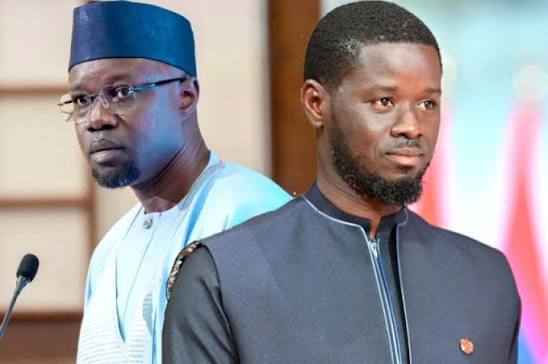


Senegal’s two most important political figures were once a partnership in the mould of Shaq and Kobe: complementary, charismatic and almost unbeatable.
In 2024, Ousmane Sonko and Bassirou Diomaye Faye were both imprisoned during the political crisis under Senegal’s former president, Macky Sall. After Faye’s release, Sonko backed him for president. Sonko, Senegal’s most prominent opposition leader, couldn’t run for president because his candidacy had been disqualified, so he backed his quieter, more institutional friend Faye instead.
“Sonko is Diomaye. Diomaye is Sonko.” That chant captured the alliance and helped carry Faye to victory. Sonko became Prime Minister. Their party, PASTEF, won 130 of 165 parliamentary seats. In less than a year, these two men went from prison to running one of West Africa’s most celebrated democracies. In Akan folklore, it was an Ananse story; too good to be true.
Now these two brilliant men were mandated to do something far harder than winning an election: GOVERN.
The Argument That Broke Everything
The previous government had failed to disclose billions of dollars in borrowing. By the end of 2024, Senegal’s public debt had reached roughly 132 per cent of GDP. The IMF suspended Senegal’s $1.8 billion lending programme and began pressing Dakar for a credible plan to address the debt crisis.
Faye met IMF chief Kristalina Georgieva on the sidelines of the Africa Forward Summit in Nairobi, where they discussed potential solutions to Senegal’s debt crisis.
Sonko lashed out publicly, saying that what the IMF is interested in is not your development. What the IMF is interested in is keeping you poor and obedient.
Sonko’s earlier opposition to IMF-backed restructuring cast the dispute as a question of economic sovereignty. Faye’s approach was more pragmatic: negotiate, stabilise and preserve access to international financing.
Two friends. Two completely different answers to Africa’s oldest question.
Do you work with the system to fix the system? Or do you reject the system entirely and build your own?
The Break
On May 22, 2026, Faye fired Sonko and dissolved the government.
Sonko’s counter-move was immediate and calculated.
He still controlled PASTEF’s parliamentary majority. He walked back into parliament and was elected President of the National Assembly with 132 votes.
Faye fired Sonko. Sonko now controlled a legislature dominated by his political movement.
Sonko declared: “Le PROS — President Ousmane Sonko is back among you. And Senegal is going to shake.”
Faye moved quickly to appoint a new prime minister and cabinet, but the political system remained locked in a confrontation with Sonko’s parliamentary majority. On July 26, Faye launched his own new party, Kiiraay, The Republican Patriots, making the split permanent.
Two men who called each other brothers are now in a constitutional standoff neither can easily escape.
Why This Is Bigger Than Senegal
Here is what makes this story important for the whole continent.
Senegal is due to lead the ECOWAS Commission from 2026 to 2030, while President Faye has also assumed the bloc’s rotating chairmanship. The country that is supposed to anchor West African democratic stability is paralysed by its own internal war.
But the deeper story is ideological.
Sonko’s earlier opposition to IMF-backed restructuring, his assertion of economic sovereignty and his argument for building from within echo the position of the military juntas in Mali, Burkina Faso and Niger. Those juntas have attracted significant support among some young people in the Sahel because they are saying out loud what millions of young Africans feel.
The West’s financial institutions have not made us prosperous. Their conditions have not made us free. We will build our own way.
Faye’s position was to engage, negotiate, stabilise, and work within existing systems resembling the approach favoured by international financial institutions and many established ECOWAS governments.
Both arguments have failed Africa at different moments in history.
Africa’s Oldest Question Has No Easy Answer
The tug of war between Faye and Sonko is about a continent trying to answer one question that has haunted it since independence.
Do you work with the world as it is imperfect, unequal and exploitative to build something better from the inside? Or do you reject it entirely and bet everything on building your own system from scratch?
The Sahel juntas chose rejection. Their populations cheered.
Faye chose engagement. The IMF is talking, but no lasting agreement has yet resolved Senegal’s debt crisis. The government is trying to stabilise the economy while managing the political cost of adjustment. Yet the youth who put him in power feel betrayed. And Sonko, the man who speaks their language, sits in the Speaker’s chair, waiting.
The ideological fault line running through Senegalese domestic politics maps directly onto the broader fracture dividing West Africa.
The argument between Faye and Sonko is the argument Africa will be having for the next generation.
“When two elephants fight, it is the grass that suffers.”
— African proverb
Faye and Sonko are the elephants.
Senegal’s 18 million people are the grass. And West Africa is watching to see which argument survives.
Tiger Rifkin decodes Africa’s tradition-transformation nexus through fearless analysis. Founder of The Witty Observer.
Keep Reading


