






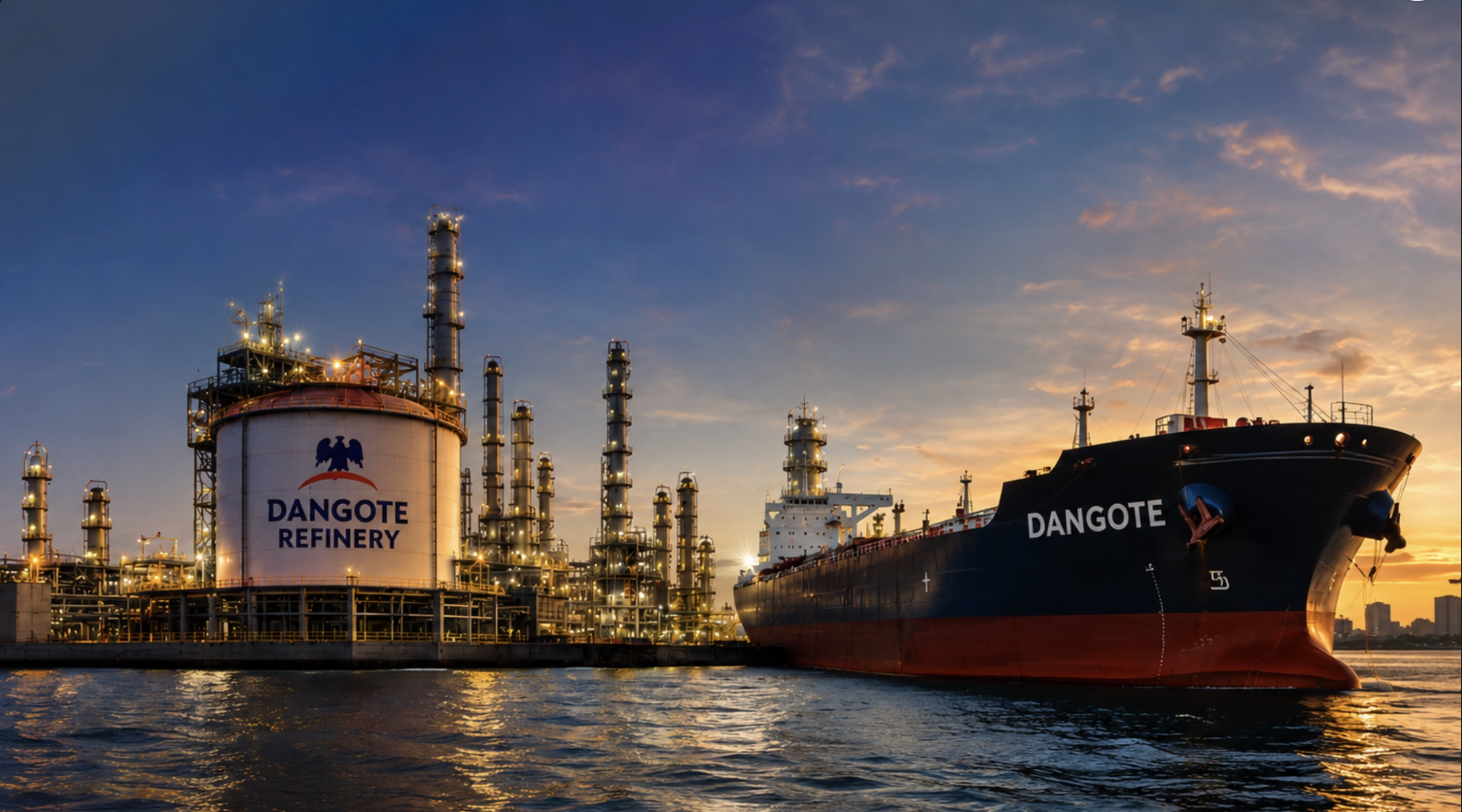


A story like this rarely gets the global attention it deserves because it disrupts the usual narrative. When a refinery in Lagos becomes Europe’s fuel lifeline, it signals a structural shift in who holds industrial power. And that is exactly why people should know about it: because it shows Africa must build more of these assets.Since disruptions at the Strait of Hormuz began, Lagos has stepped in.
The Dangote Refinery briefly became Europe’s largest supplier of aviation fuel. This is a story about industrial power and Africa’s ability to shape global markets.
Since February 2026, conflict around the Strait of Hormuz has disrupted global energy markets. Tanker insurance premiums multiplied. Shipping routes shifted. Europe went looking for alternative fuel supplies. Guess who had the capacity?
Lagos.
The Dangote Refinery at Lekki had reached full production just as the crisis escalated, 650,000 barrels per day, the largest single-train refinery on earth. The Atlantic route to Rotterdam bypasses the Suez Canal, the Red Sea, and the Strait of Hormuz entirely. No war risk premium. No IRGC patrol boats. Just open ocean.
Buyers noticed.
In June 2026, the Dangote refinery shipped approximately 466,000 metric tonnes of jet fuel to Europe, overtaking the United States as Europe’s largest supplier of aviation fuel. Nigerian jet fuel flows to Europe nearly doubled from May to June. US shipments fell from a record 818,000 metric tonnes in April to 399,000 metric tonnes in June over the same period.
For one month, Lagos outshipped America in European skies, according to S&P Global data.
But context matters.
This was one month. Prices had already peaked and were falling sharply by June. The European jet fuel benchmark dropped from a record $1,694 per metric tonne in March to $982 by the end of June. Flows from the UAE through the Suez Canal were already resuming. Saudi Arabia and India were scaling exports back up. The market was oversupplied, partly because Dangote and US refiners both flooded it simultaneously.
The moment was real. Its permanence is not yet proven.
Tiger’s Roar
Here is what the moment actually revealed.
For decades, Nigeria pumped crude oil into tankers and imported the refined products made from its own petroleum. The Dangote refinery broke that cycle not through government policy, not through continental strategy, but through one man’s $20 billion industrial bet over twenty years.
When the geopolitical shock came, the capacity was there. That is what preparation looks like.
But Africa’s energy story cannot rest on one refinery, one company, one industrialist. Dangote is now finalising a second refinery of 700,000 barrels per day in Lamu, Kenya. The continental ambition is genuine.
The structural lesson, though, is bigger than one man’s next project.
When Africa builds real industrial capacity, it earns real options during global disruption. The Hormuz crisis revealed Dangote Refinery’s relevance. My next question is, when is Africa building the next one in each region?
Africa has been the raw material for a century. No, it is refining the fuel that keeps European planes in the air.
It is not yet worth declaring victory, but you should know that we can do it.
Tiger Rifkin decodes Africa’s tradition-transformation nexus through fearless analysis. Founder, The Witty Observer.
Keep Reading


