






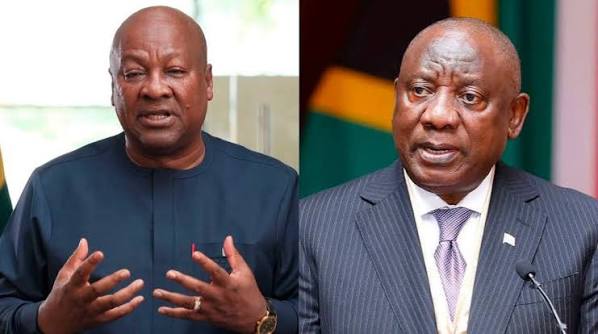


South Africa has one of Africa’s most developed financial systems and remains a major economic power on the continent.
Ghana is neither the largest nor the wealthiest; however, it remains the intellectual and symbolic cradle of Pan-Africanism, providing a historic blueprint for continental unity.
Ghana and South Africa are siblings. Siblings fight. This is not a crisis; it’s a family matter. And when a sibling goes wrong, you don’t abandon them. You call them to account. You demand they do better. And then you hold the door open.
South Africa is the lion. Ghana is the honey badger. The lion is bigger, stronger, and built to dominate. But ask any wildlife expert what happens when a lion picks a fight with a honey badger. The lion backs down. Why?!. Because the honey badger makes winning too expensive. South Africa knows this. The whole continent is watching.
Ask the British and confirm with the French: within six years of Kwame Nkrumah leading Ghana to independence, 24 African countries had claimed their own freedom. Nkrumah didn’t just liberate Ghana. He proved that colonial power is defeatable.
Through a formal petition, Ghana asked the African Union to examine the situation and place xenophobic violence on the agenda of its next summit.
Ghana is calling for a conversation. Come to the table. Acknowledge what is happening and let’s fix it together.
South Africa has every right to enforce its immigration laws; what South Africa does not have the right to do is outsource enforcement to angry citizens.
The table is still set, South Africa. Come sit down.
Full piece dropping Tuesday. Follow The Witty Observer.
South Africa has every right to enforce its immigration laws, but South Africa does not have the right to outsource enforcement to angry citizens.
It is alleged that a Congolese woman in South Africa was filmed destroying her own salon equipment after being pressured by a local group to hand over her business.
These are the human costs of a country that has allowed anger to outrun law.
Xenophobia is not immigration policy. A mob is not the state. A civilian deadline is not law. And when the government watches intimidation gather force without acting decisively, it creates the conditions for violence.
Many South Africans dispute the label. So let’s look at this differently: Human Rights Watch, Amnesty International, the United Nations Office of the High Commissioner for Human Rights, and South Africa’s own Wits University have documented xenophobic violence in the country since 1994. So South Africa denies Ghana’s claims. Fair enough. Are they also disagreeing with its own academics and the reputable institutions listed above?
South Africa has every right to enforce its immigration laws. However, South Africa does not have the right to outsource that enforcement to angry mobs.
Illegal migration is a real governance challenge, and South Africa cannot be expected to absorb an unlimited number of undocumented migrants, which would strain public services. Nevertheless, the legitimate concern does not justify humiliation, vigilantism, or violence.
Countries deport undocumented migrants every day through courts, police, and due process. Do the same, and people will be returned to where they came from. But don’t beat them in the street, destroy their livelihoods on camera, and then have government officials deny it in public.
In South Africa, you have the institutions to do this properly. Do so now. You are not showing any urgency or discipline to control the mobs. That is why Ghana’s response matters.
Ghana is calling for accountability. When Ghana petitioned the African Union for an official probe and fact-finding mission. What they were saying is something simpler: fix this mess.
That is a fair position. Africa cannot build unity on the silence of abused Africans. And it cannot pretend that anti-immigrant violence is a local issue with no continental meaning. When a Ghanaian is killed in South Africa, and a Congolese woman is allegedly pressured into destroying her own shop, the whole continent must pay attention.
South Africa’s government must take charge of its own streets. Deport undocumented migrants lawfully and humanely. Prosecute those who organise civilian deadlines and incite attacks. Protect foreign nationals with the same force of law it owes its own citizens.
And Africa must do its part too. The continent needs a real migration framework: legal pathways, documentation systems, and coordinated enforcement through the African Union. AfCFTA cannot mean much if Africans fear crossing African borders.
The Congolese woman destroyed her own salon. Bashiru Isak never came home.
South Africa’s government must answer for that. The table is set. Come sit down.
Tiger Rifkin decodes Africa’s tradition-transformation nexus through fearless analysis. Founder, The Witty Observer.
Keep Reading


