



By Tiger Rifkin | The Witty Observer
“The Igbo generally had no Kings or Chiefs. However, few towns like Onitsha had what looked like a recognized chief. The Igbos operated a democratic system of Government.” — West African Research Association, Journal of West African Studies (2021)
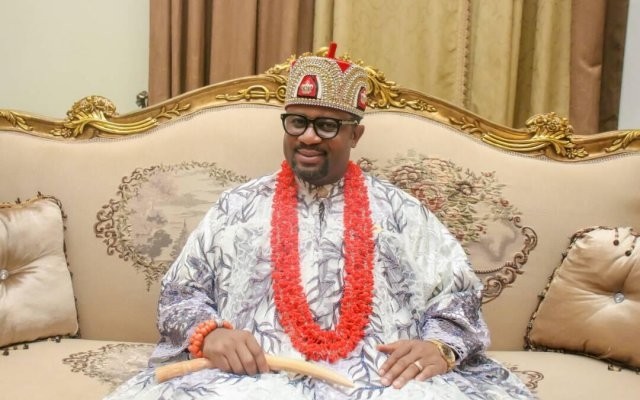
The African diaspora is disappointed in Ghana. They see His Royal Majesty Eze Dr Chukwudi Jude Ihenetu’s controversy as proof that Africans reject unity while embracing colonial divisions.
But here’s the sophisticated truth they’re missing: An “Igbo King” shouldn’t exist in the first place. And their disappointment reveals more about colonial education than traditional sovereignty.
What’s happening in Ningo-Prampram isn’t just about one self-styled king. It’s about a man claiming a title his own culture never recognized.
The Case: Eze Chukwudi’s Agenda
His Royal Majesty Eze Dr Chukwudi Jude Ihenetu was crowned “Eze Ndi Igbo Ghana” in Accra. Claims to have acquired 50 acres in Old Ningo for an “Igbo Village” – palace, town hall, guest houses.
Here’s the first problem: Traditional Igbo society had no kings. The Igbo operated a republican system with “no centralization of power” and “no traditional rulers in the form of Kings. They practiced what scholars call an “acephalous political system” – chiefless and egalitarian.
With rare exceptions like the sacred Nri Kingdom and trading cities like Onitsha, “title holders were respected because of their accomplishments and capabilities. They were not revered as kings but often performed special functions given to them by such assemblies.
So an “Igbo King” claiming territory violates both traditional Igbo governance AND traditional Ghanaian sovereignty.
His stated mission: “To protect, defend, and project the Igbo people… We have no political authority or territorial ambitions in Ghana. This is purely cultural.”
Unlike global micronations that operate in legal gray areas, Eze Chukwudi’s claim confronts established traditional authority. Territory with ancient governance systems.
Both traditional councils responded decisively:
• Ga Traditional Council: “Cease calling yourself Igbo King in Ga State”
• Ningo Traditional Council: Emergency meetings. Denial of land sales. Calls for government intervention.
MP Sam George was blunt: “No ‘King’ has any kingdom or land in the Ningo-Prampram Constituency.”
Everyone’s asking the wrong questions.
When Kingdoms Crossed Borders
Pre-colonial African kingdoms regularly operated across territories. Yoruba Obas governed settlements spanning Nigeria to Togo. Ashanti sub-chiefs ruled distant trading communities. The difference: negotiated authority, not unilateral land claims.
The Ningo Reality: Whose Land, Whose Rules?
Eze Chukwudi claims territory in Ningo-Prampram. Land governed by the ancient Great Ningo Kingdom under Nene Osoroagbo Djangmah XII.
This isn’t abstract. It’s indigenous sovereignty meeting diaspora ambition.
The Great Ningo Kingdom predates Ghana by centuries. Traditional authority. Customary law. Territorial protocols have developed over generations.
When Eze Chukwudi bypassed these protocols, claiming land without engaging traditional authorities first, he violated African sovereignty systems. Systems far older than colonial nationalism.
The irony: An African king ignoring African kingship protocols while claiming to preserve African culture.
The Diaspora Blind Spot
The African diaspora defending Eze Chukwudi reveals a profound misunderstanding. They learned “Africa” through colonial maps that erased indigenous complexity.
What they see: Artificial borders dividing African people. What they miss: Traditional territories with legitimate sovereignty claims.
The diaspora narrative: “These colonial borders are blocking African unity.” Traditional authority response: “This isn’t about borders. It’s about protocols.“
Eze Chukwudi’s approach is acquiring land and declaring cultural sovereignty. This precisely follows European colonial patterns. It contradicts African diplomatic traditions.
Cultural Leadership vs. Territorial Claims
Cultural leadership: Representing diaspora communities. Organizing cultural events. Mediating disputes.
Territorial sovereignty: Claiming land. Establishing parallel governance. Naming streets.
Examples of successful African diaspora leadership:
• Eze Igbo in Kano, Nigeria – Cultural representation with community and government recognition
• Igwe Japan – Symbolic cultural leadership without territorial claims
These work because they respect both cultural identity and territorial sovereignty.
Eze Chukwudi’s challenge: His 50-acre “Igbo Village” crosses the line from cultural leadership into territorial establishment. Requires negotiation with existing traditional authorities.
The Sophisticated Solution
The way forward isn’t choosing between Pan-African ideals and traditional sovereignty. It’s remembering how our ancestors managed both.
Traditional African diplomacy had frameworks:
• Tributary relationships – Cultural communities contributing to local development
• Marriage alliances – Cementing relationships between different groups
• Trade partnerships – Economic integration, building political cooperation
• Cultural exchange protocols – Respecting territorial authority while maintaining cultural identity
Modern application:
- Engage traditional authorities first
- Negotiate mutual benefits
- Respect territorial protocols
- Build gradual integration
Tiger’s Roar

The Eze Chukwudi controversy isn’t about rejecting African unity. It’s about recognizing that unity requires protocols.
The African diaspora asking “Why can’t Africans unite?” should ask “How did African kingdoms traditionally manage cultural diversity?”
Continental Africans defending territorial sovereignty should ask, “How do we honour traditional authority while enabling African mobility?”
If you aspire to be an African king in an African territory, adhere to traditional African diplomatic practices. Don’t act like a European colonizer and then cry about African unity when people resist.
The most African solution won’t be found in European concepts of citizenship and immigration. It will be found in indigenous diplomatic traditions that enabled kingdoms to become empires without erasing local sovereignty.
Our ancestors knew better. They built networks spanning continents while respecting local kingdoms. They created unity through diversity.
The question isn’t whether an Igbo king should exist in Ghana. It’s a question of whether 21st-century Africa can rediscover the diplomatic wisdom that made ancient kingdoms into lasting empires.
Because the most African solution will honour both cultural identity and territorial sovereignty. That’s what our ancestors did.
Subscribe on LinkedIn: Drums, Data & The Tiger’s Den
#AfricanSovereignty #PanAfricanism #IndigenousGovernance #DiasporaRelations #TraditionalAuthority #AfricanUnity
Tiger Rifkin. Pan-African strategic communicator decoding Africa’s tradition-transformation nexus. Creator of The Witty Observer. Bold commentary on African geopolitics. Economic sovereignty. Leadership. Ancestral wisdom meets modern strategy.