


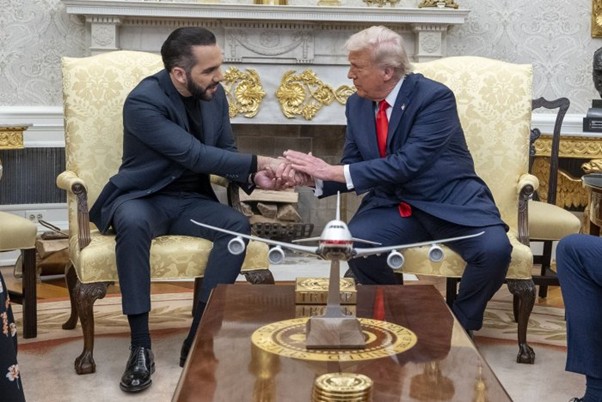

If Nayib Bukele were African, Washington would be screaming “dictator.” Instead, they’re cheering him on.
There’s an old English proverb first recorded in 1670: “What’s good for the goose is good for the gander.”
Unless the goose is in El Salvador and the gander is in Africa.
Last week, El Salvador’s Congress voted to eliminate presidential term limits, clearing the way for Bukele to potentially rule indefinitely. The vote passed 57-3 on July 31, 2025, extending presidential terms from five to six years and eliminating runoff elections.
The U.S.? Not just quiet, they’re supportive. The IMF? Still at the table. And the Western media? Mildly concerned but largely impressed.
The State Department’s official position: “El Salvador’s Legislative Assembly was democratically elected to advance the interests and policies of its constituents. Their decision to make constitutional changes is their own.”
Why? Because it’s working.
Bukele has slashed gang violence by 95%, reduced homicide rates to historic lows, and turned El Salvador from “murder capital” to tourist destination in less than five years. The methods? Mass arrests of 86,000+ suspected gang members (over 1% of the population), many held without traditional due process. A state of emergency that suspended constitutional rights. And yes, a nervous democratic class.
But here’s what critics miss: Salvadorans overwhelmingly support these measures. 90%+ approval ratings don’t lie. When your choice is constitutional purity or your children walking safely to school, most parents choose safety.
So here’s the real question: Why is rule-breaking strategic in San Salvador but reckless in Ouagadougou or Kigali?
The Hypocrisy is Loud
When an African leader tweaks the constitution, Western embassies host candlelight vigils for democracy. But when Bukele does it? It’s a “constitutionally sound legislative process.”
When Magufuli bulldozed corruption in Tanzania, he was slammed as authoritarian. When Bukele builds CECOT mega-prison? It’s “innovative security policy.”
When Rwanda prioritizes stability over Western-style pluralism, the New York Times calls it “authoritarian consolidation.” But Bukele? “Effective governance.”
The pattern is clear: What Washington condemns in Africa, it celebrates in Latin America when the results align with American interests.
Human Rights Watch director Juanita Goebertus warned that Bukele is “following the same path as Venezuela.” The State Department’s response? “We reject the comparison of El Salvador’s democratically based process with illegitimate dictatorial regimes.”
Same constitutional changes. Different hemispheres. Different standards.
Africa Must Also Learn to Break the Rules
And not in the name of power but in the name of performance.
Let’s be honest: Africa didn’t invent most of the rules it’s now punished for breaking. Our constitutions are cut-and-paste copies. Our governance models are imported. Our elections are monitored like children taking exams they didn’t write.
It may be time to stop apologizing.
If rules fail to deliver justice, peace, and dignity, then it’s time to rewrite them. Not to crown strongmen, but to build strong systems. Systems that reflect African realities, not foreign textbooks.
Bukele’s real lesson: Build what works—and own it.
The man who calls himself “the world’s coolest dictator” told his critics in June: “I’d rather be called a dictator than see Salvadorans murdered in the streets. When I check my phone, I’d rather read ‘dictator, dictator, dictator’ in the headlines than see ‘murder, murder, murder.'”
Results over rhetoric. Outcomes over optics. Performance over performative democracy.
Africa’s Governance Cannot Be Fear-Based
Too many African leaders govern in fear: fear of coups, fear of donors, fear of bad press. So they follow rules like robots, even when those rules trap their people in poverty, paralysis, or performative democracy.
But people don’t eat constitutions. People feed on results. Currently, Africa has too many rules and not enough results.
This is not a call for dictatorship. It’s a call for audacity. To innovate. To localize leadership models. To build governance that’s not just legal—but legitimate.
The Bukele Standard: If your people’s safety, prosperity, and dignity improve dramatically, the world will find ways to justify your methods retroactively.
Tiger’s Roar

“The West taught Africa to follow the rules. But Bukele just proved that when the rules don’t work, the brave rewrite them. Africa doesn’t need another strongman. But it desperately needs strong results and the courage to choose what works over what’s imported.”
Secretary of State Marco Rubio praised Bukele’s “leadership and crackdown on criminal gangs” long before the constitutional changes. Trump called El Salvador “a model for regional security cooperation.”
Translation: Deliver results Washington likes, and they’ll find reasons to support your rule-breaking.
The uncomfortable truth: Washington’s democracy promotion has always been selective. What’s new is how transparent they’ve become about it.
The Call to Action
So here’s the final thought: If Washington can stomach El Salvador breaking the rules for progress, Africa must have the stomach to break them for survival.
Opposition lawmaker Marcela Villatoro warned that “Democracy has died in El Salvador today.” But Bukele maintains 90%+ approval ratings because his people prefer safety to abstract democratic theory.
The African question: What if our people prefer functioning hospitals to functioning parliaments? Working schools to working elections? Safe streets to perfect constitutional compliance?
Maybe it’s time to stop asking permission. And start delivering results that make the critics irrelevant.
Sources: CNN International, NPR, Washington Post, Al Jazeera, U.S. State Department statements, El Salvador Legislative Assembly records
#Africa #Governance #Leadership #ElSalvador #PanAfricanism #Bukele #DemocracyDebate #TheWittyObserver
Tiger Rifkin. Pan-African strategic communicator decoding Africa’s tradition-transformation nexus. Creator of The Witty Observer. Bold commentary on African geopolitics. Economic sovereignty. Leadership. Ancestral wisdom meets modern strategy.